The ochre of Muscat’s sun-bleached stone bleeds into the bruised, saline turquoise of the Gulf, creating a chromatic friction that feels like a Morandi still life caught in a gale. It’s a haunting, dusty palette; I’ve found myself shivering at the way that pale, chalky sand-yellow clings to the steel hulls. One doesn't just see the maritime commerce here, one feels the heavy, humid weight of the light pressing against the ancient, salt-crusted docks.
The rusted steel and weathered stone of Muscat’s docks create a rugged, monochromatic stage that feels almost tactile. I’m struck by how the harsh, salty light clings to the cargo containers, grounding the subject in a world of industrial transition. When I finally look at the man, he doesn't just inhabit this space; he’s an extension of its maritime grit. It’s a beautiful, weary dialogue between a human life and the heavy, globalized machinery of trade.
Muscat breathes through its harbor, and here, we feel the salt air clinging to the steel of those distant ships. Aude-Emilie didn’t just frame a port; she listened to the rhythm of the tide against the old stone. It’s a quiet conversation between ancient heritage and modern commerce. I find myself leaning in, searching for the souls behind the cargo. It’s a photograph that asks to be returned to, lingering like a story told at dusk.
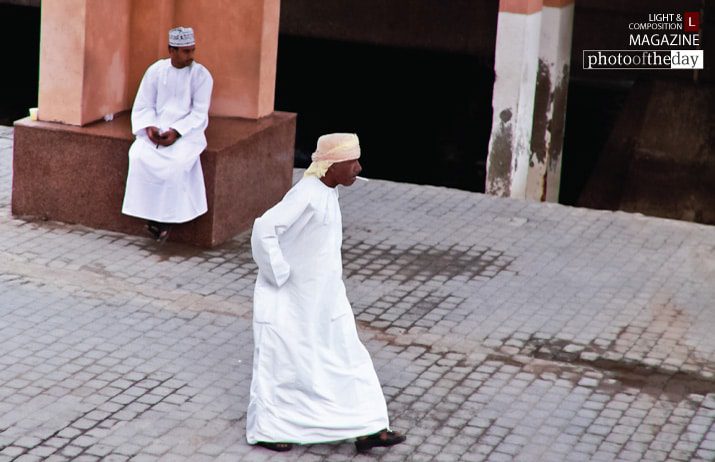
Muscat’s docks are busy, but the soul here isn't in the cargo. It’s in the man’s eyes. He’s looking right at us, and there’s a quiet, weary dignity in his posture that suggests he’s fully aware he’s being seen. I feel a sudden, sharp ache in my chest looking at his hands—they’ve clearly done the heavy lifting of this city. He didn't just happen to be there; he gave us a piece of himself.
Muscat’s harsh light flattens the urban grain here, turning the historic fabric into a mere backdrop for global commerce. I’m struck by how the containers dwarf the traditional fenestration, creating a jarring shift in scale. It’s a cold, transactional view that ignores the threshold between land and sea. I wish the frame breathed more; it feels claustrophobic, missing the salt-air rhythm of the port. It’s a sharp, honest lie about a city losing its datum.
f/8 at 1/250s, ISO 200, 35mm. A standard aperture for street work, yet it’s the only logical choice here. The depth of field holds the cargo containers and the dhows in equal focus, grounding the juxtaposition. It’s technically sound, though I’ve always found the lack of motion blur in the water a bit sterile. Still, the math holds up. The exposure is precise. It’s a clean, calculated document of Muscat’s trade. I respect the discipline.
Looking at Muscat’s harbor, I can’t help but crave the descent. Above the surface, the light is harsh, unfiltered, and relentless. Down here, we’re constantly battling the refractive index and the brutal absorption of the red spectrum. Aude-Emilie’s work captures the city’s edge, but I’m distracted by the water’s surface tension. It’s a boundary I spend my life crossing. I’d give anything to see what’s lurking beneath those hulls, hidden from the sun’s bleaching glare.
You’ve caught the quiet weight of Muscat’s docks, where the steel of modern commerce meets the ancient pull of the tide. I’ve spent enough time in ports to know that smell of salt and diesel. You waited for the right light to bridge that gap between the ships and the stone. It’s a lonely, honest frame. And honestly, it makes me miss the road. You felt the city’s pulse, and it shows.
Most street photography in Muscat settles for the postcard aesthetic, but this frame resists that trap. By anchoring the modern cargo against the historic port, Aude-Emilie captures a city in a quiet, existential tug-of-war. I’ve seen thousands of maritime shots, yet this one lingers because it doesn't romanticize the transition; it documents the friction. It’s a rare, honest look at progress. Honestly, it makes me feel a bit nostalgic for a world that’s already disappearing.
The frame’s architecture relies on the rigid geometry of the cargo containers against the fluid horizon. It’s a precarious balance. The verticality of the cranes imposes a necessary order upon the chaotic maritime sprawl. I’m genuinely unsettled by how the negative space threatens to collapse the entire composition. It doesn't offer comfort, only a stark, structural confrontation. The fulcrum of the frame holds, but it’s a fragile victory. The visual weight remains perfectly, coldly distributed.


 Tanmoy Saha
Share your thoughts about this award-winning photograph. Your reviews contribute to the community engagement score.